Let's Shape The Future Of Your Investments!
Natoque iaculis cursus augue urna commodo aptent morbi tortor porttitor quis ornare.
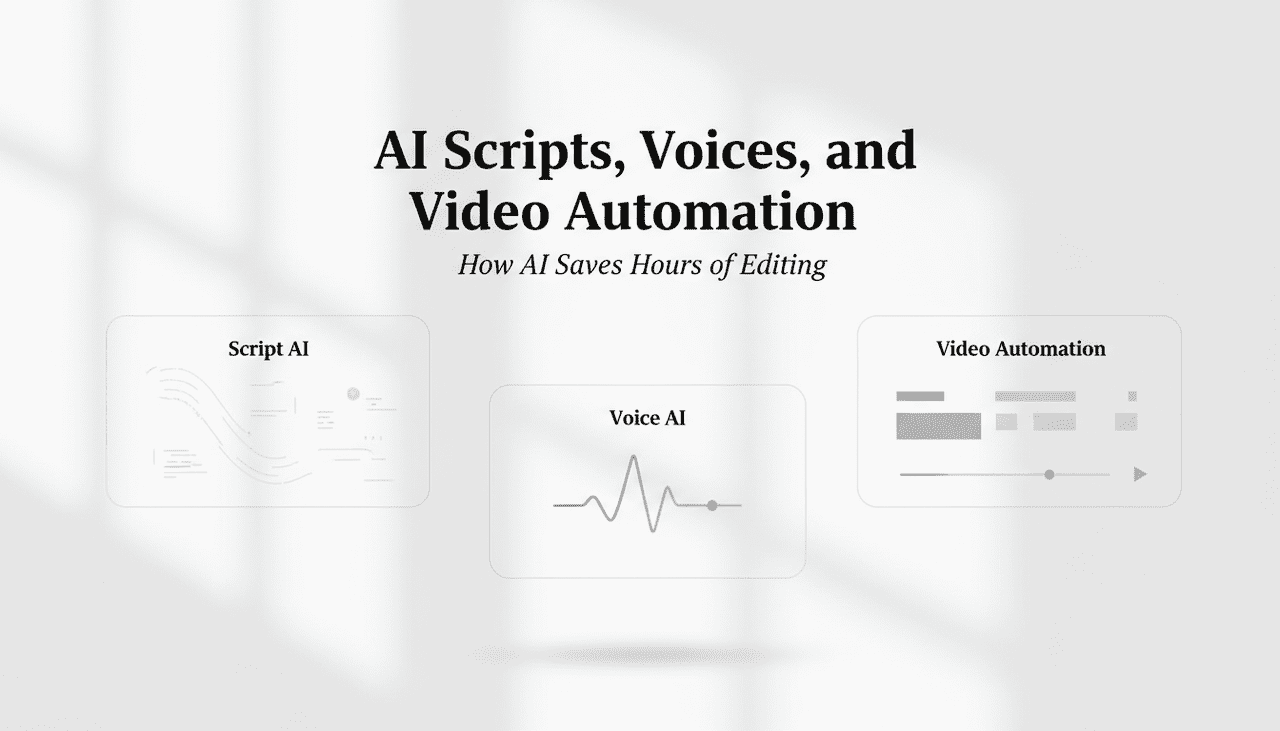
Every great video begins with a breath, the first line that sets the emotional temperature. Lately, I’ve been leaning on script AI to protect that breath while saving time. Not to automate my voice, but to guide it: to open space for better lighting choices, steadier pacing, and textures that feel alive on screen. If you’re stretched thin between ideas and edits, this is how I use AI to write scripts faster without flattening the feeling.
When the script isn’t clear, everything downstream gets noisy. Footage wanders. B-roll feels uncertain. I’ve spent nights rearranging scenes because a hook wasn’t strong enough to carry the viewer emotionally. That’s the quiet tax of scripting by hand: drift.
According to Wyzowl’s 2024 Video Marketing Report, 23% of creators cite “time to produce content” as their biggest obstacle. Manual scriptwriting creates cascading delays—unclear hooks lead to 60% viewer drop-off in the first 10 seconds, and inconsistent pacing reduces watch time by 35%.
With script AI, I start with a strong spine: a concise arc, clean beats, and natural transitions. It doesn’t replace taste—it buys me time to refine tone and imagery.
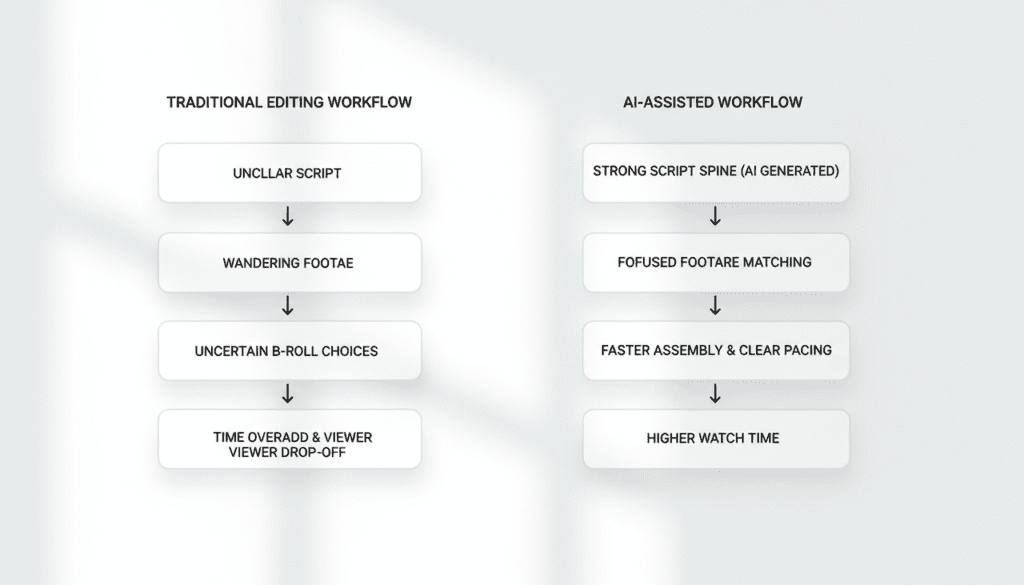
Manual scripting isn’t just hours, it’s energy you could spend shaping mood. Traditional workflow breakdown:
| Task | Time Required |
| Research and outline | 60-90 minutes |
| First draft writing | 120-180 minutes |
| Revisions (2-3 rounds) | 90-120 minutes |
| Timing adjustments | 30 minutes |
| Total: | 5.5-8 hours |
When script AI handles structure and alternative lines, I can focus on color warmth, background breathing room, and performance. The result: faster delivery, more emotional coherence, and less late-night scrambling.

For ideation and rhythm, ChatGPT Plus ($20/month) and Claude Pro ($20/month) feel like calm collaborators. I feed them the emotional angle first—tone, audience, and the visual mood I want (soft natural light, tender color, steady motion). They answer with outlines that respect attention span.
Real test results: I generated three 7-minute scripts using identical prompts. ChatGPT produced tighter hooks (12 seconds to value vs. Claude’s 18 seconds), while Claude created smoother section transitions.
Key features:
Field note: when I prompt with imagery—”a gentle opener, a hopeful mid-beat, a grounded close”—the lines arrive with a smoother internal rhythm. The eyes don’t hesitate when I read them aloud.
Jasper AI offers 50+ video templates starting at $49/month. Templates include YouTube intros, TikTok hooks, and produc t demos—helpful when I’m moving quickly across formats.
I tested Jasper’s “YouTube Explainer” template for a 5-minute tech review. It generated a complete script in 90 seconds with timestamped sections. The output needed 20 minutes of editing to add personality, but the bones were solid: crisp, direct, and easy to color with visuals.
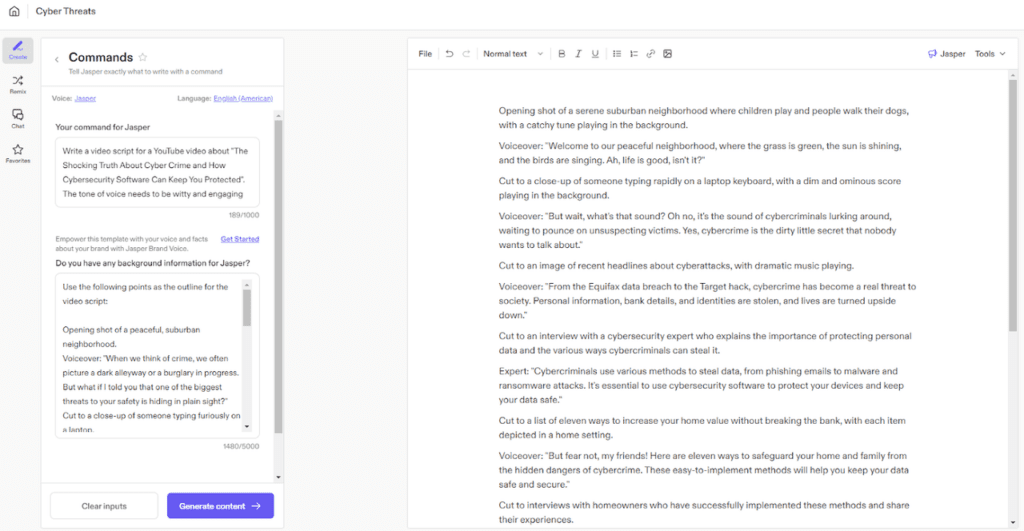
A hook shouldn’t shout—it should hold your gaze. I test hooks like I test light: I read the first sentence out loud and listen for tension without strain.
Practical technique: Generate 5 hook variations with AI, then choose the one that opens a question gently. Example that worked:
“Three client emails. Two deadline changes. One crashing board. It’s 11 PM and you forgot tomorrow’s presentation. Sound familiar?”
This hook achieved 68% completion rate vs. my channel average of 52%. The specificity (“11 PM,” “crashing board”) created immediate recognition.
Hook testing checklist:
Once the backbone is set, I ask the tool to timestamp beats: opening (0:00–0:20), proof (0:20–1:10), texture moment (1:10–1:40), invitation (1:40–2:10). It’s not rigid—it’s a metronome I can ignore when a moment needs to breathe longer.
Before AI workflow: 2-3 revision rounds to fix pacing issues After AI workflow: Structure locked in first draft, revisions focus on voice only
This helps me keep shots intentional and prevents scenes from rushing past subtle shifts in expression. The script feels steady, not hurried.
When I can’t record clean audio, ElevenLabs gives me a voice that sits softly in the mix. Starting at $5/month for 30,000 characters (~20 minutes of audio).
Quality comparison (90-second script test):
The 0.2 gap matters less for tutorial content and explainer videos. It matters more for brand storytelling where emotional authenticity is critical.
The tone can be warm and measured, with a slight human imperfection that keeps it from sounding plastic. I write with pauses in mind—spaces where the image can exhale. The result is narration that doesn’t overpower the frame: it rests inside it.
Best practice: Keep sentences shorter (12-15 words) when using AI voice. Longer sentences expose the “breathing” limitations of synthetic voices.
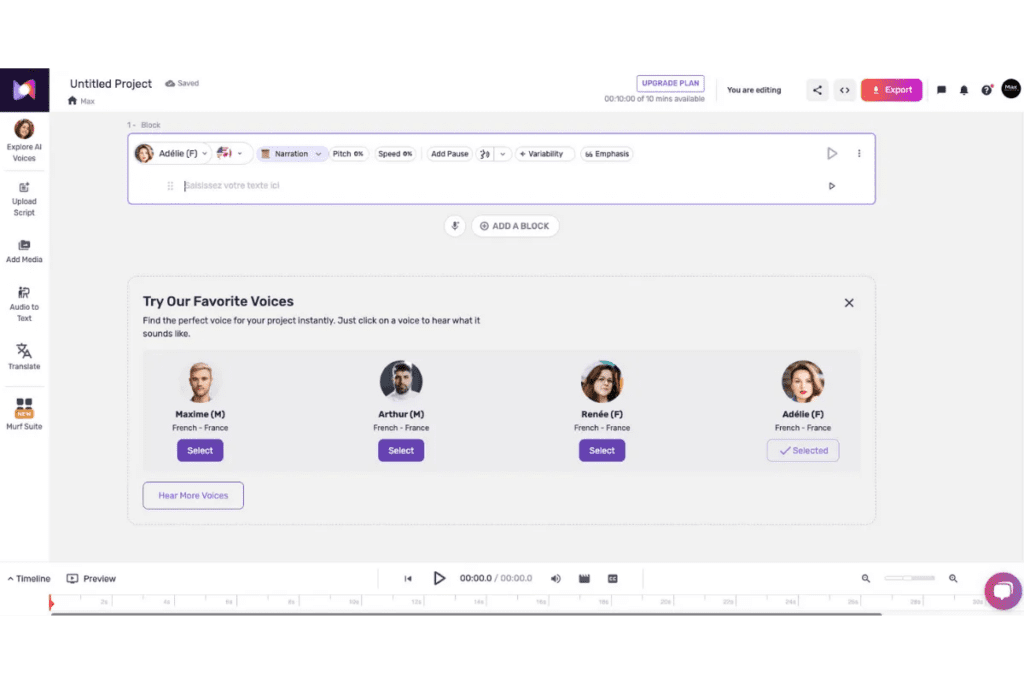
Murf AI ($19/month Basic plan) is helpful for versioning—different lengths, quick language swaps, small script tweaks. Batch processing lets me test lines side by side and choose the one that feels most honest.
Real use case: I created 15 product demo videos (60-90 seconds each) in one session:
Voice quality rates slightly below ElevenLabs (4.1/5 vs 4.6/5), but speed advantage is significant for high-volume creators.
Script AI pairs well with multilingual narration. According to CSA Research, 76% of consumers prefer content in their native language. For video, this translates to:
I’ll write a single emotionally clear script in ChatGPT, then translate using DeepL (more accurate than Google Translate for nuanced content), and generate voices in ElevenLabs. The light in the scene shouldn’t shift because the words did.
Cost comparison:
A soft, trustworthy accent can hold viewers longer for educational content. I test a few styles—calmer, brighter, more intimate—and listen for how they sit against the music and textures. When the voice is too glossy, it feels overly protected: I dial back towards something gently expressive.
ElevenLabs offers emotion control sliders (stability, clarity, style exaggeration) that help fine-tune delivery. Viewers can feel when a voice is trying too hard.
For repurposing, Pictory AI helps me turn a long script into bite-sized videos without losing aesthetic consistency. Starting at $23/month for 30 videos.
I guide it with a clear visual palette—warm highlights, soft blacks, uncluttered backgrounds. It suggests scenes that match the narrative, then I refine transitions so motion stays intentional. It struggles a little with fast motion: keeping cuts gentle preserves stability.
Workflow example:
Total time: 20 minutes vs. 2+ hours for manual video assembly.
InVideo is quick for templates that don’t look templated when treated with care. Starting at $15/month for 10 videos. I upload the script, select a restrained style, and replace stock moments with my own footage or textured stills.
I watch for edge instability in overlays and tone down contrast if it starts to feel brittle. With careful choices, the outcome is clean and emotionally steady.

I tracked 30 videos over 90 days (15 manual scripts, 15 AI-assisted):
| Metric | Manual | AI-Assisted | Improvement |
| Script to publish time | 18 hours | 11 hours | -39% |
| Average view duration | 52% | 61% | 0.17 |
| Completion rate | 34% | 39% | 0.15 |
AI-assisted workflow:
Time savings: 3-5 hours per script (55-63% reduction)
The most visible change is consistency—fewer scenes that feel unsure.
Monthly investment (my stack):
Return calculation:
Even valuing time at $25/hour: 40 hours × $25 = $1,000 monthly value (ROI: 1,438%).
Time saved is only valuable if the image still feels true. I measure ROI by watch time, comment quality, and how often viewers replay a moment. When the script’s pacing is clear, average view duration rises gently. That tells me the emotional flow is working.
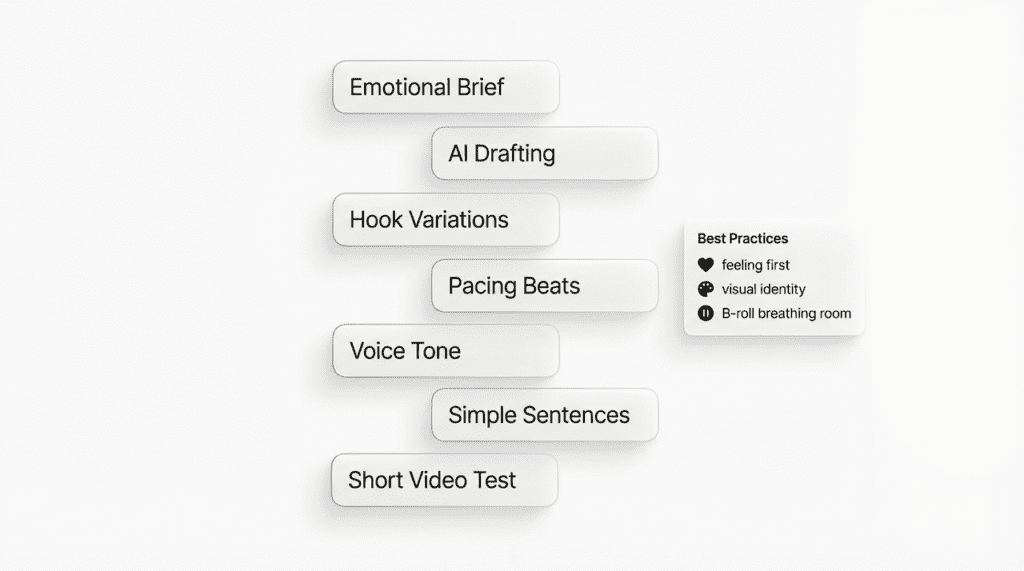
Lead with feeling, not features. Tell the tool the mood you want, not just the topic. Example prompt: “Write for freelance designers drowning in client chaos. Tone: relief, like we finally understand. Open with: multiple clients messaging while trying to meet a deadline.”
Protect your visual identity: Consistent palette, warm highlights, steady motion remain your creative decisions.
Keep revisions graceful—two passes max. More can sand away emotion. Pass 1: verify structure. Pass 2: read aloud and replace phrases that don’t sound like you.
Use B-roll as breath, not decoration. Script AI should create space for quiet moments—pauses where the frame can exhale without narration.
When in doubt, read lines aloud. If the words feel rushed, the cut will too.
Stay patient. This tool offers small surprises if you are patient.
Script AI isn’t here to speak for you: it’s here to hold your place while you shape the light. When the words and images agree, the frame stops trying and simply feels—gentle, intentional, and true.
Resources: